Automated Parking Testing Enters the Centimeter-Level Era: The Importance of High-Precision Indoor Positioning Under the Latest Test Standard (GB/T 47031-2026)
With the rapid popularization of automated parking functions in the passenger vehicle sector, capabilities such as parking in and out, parking cruising, and autonomous parking in complex environments are becoming an essential part of intelligent driving. To standardize the relevant technical verification processes, the industry has recently released automated parking test standards that put forward more systematic requirements for test scenarios, test conditions, and test accuracy.
Judging from the content of the standards, automated parking testing is transitioning from single-scenario verification to a systematic testing phase in complex, multi-scenario, and repeatable environments. In this process, high-precision positioning capability has become the key foundation supporting the entire testing system.
Three Important Signals Released by Automated Parking Test Standards
By analyzing the content of the standards, we can see that the current automated parking test system presents three distinct trends:
1. Test Scenarios Expanding from Single Parking to Full-Process Capability Verification
The standard requires the coverage of various typical automated parking scenarios, including:
Automated parking into a space
Automated parking out of a space
Straight-lane cruising
Curved-lane cruising
Ramp cruising
Speed bump crossing
Barrier gate recognition
Dynamic obstacle avoidance
These scenarios fundamentally cover the core working conditions in real parking lot environments, making testing closer to real-world user conditions. This also means that the test system must not only record the parking maneuver itself, but also continuously measure and evaluate the vehicle's trajectory, speed, and dynamic response throughout the entire parking process.
2. Significant Increase in Test Accuracy Requirements
The standard sets explicit accuracy requirements for testing equipment:
Dynamic position accuracy: ≤ 0.10 m
Static position accuracy: ≤ 0.01 m
Outdoor speed accuracy: ≤ 0.1 km/h
Indoor speed accuracy: ≤ 0.3 km/h
Sampling frequency: ≥ 50 Hz
These metrics indicate that traditional testing methods relying on standard GNSS or visual measurements can no longer meet the demands. Testing systems must now possess centimeter-level positioning and high-frequency data collection capabilities.
3. Dynamic Target Cooperative Testing Becomes a Key Capability
In obstacle avoidance tests and similar scenarios, the standard requires the vehicle to successfully handle:
Pedestrian crossing
Dynamic vehicle interference
Target vehicle pulling out
Multi-target cooperative scenarios
Therefore, the test system must not only achieve high-precision measurement of the primary vehicle, but also enable precise control and trajectory reproduction of dynamic targets to ensure the stability and repeatability of the test scenarios.
Indoor Testing: A Major Challenge for Automated Parking Verification
A massive number of application scenarios for automated parking are concentrated in underground parking lots or indoor parking garages. However, in these environments, navigation satellite signals are typically heavily obstructed, and traditional GNSS positioning cannot function stably. This poses a new challenge for high-precision testing. Achieving GNSS-like positioning capabilities in indoor environments has become a critical issue in building an automated parking testing system.
VIPS: Building High-Precision Indoor Positioning Infrastructure
Against this backdrop, the VIPS (VBOX Indoor Positioning System), introduced by the British company Racelogic, is emerging as a vital technical solution for indoor autonomous driving testing.
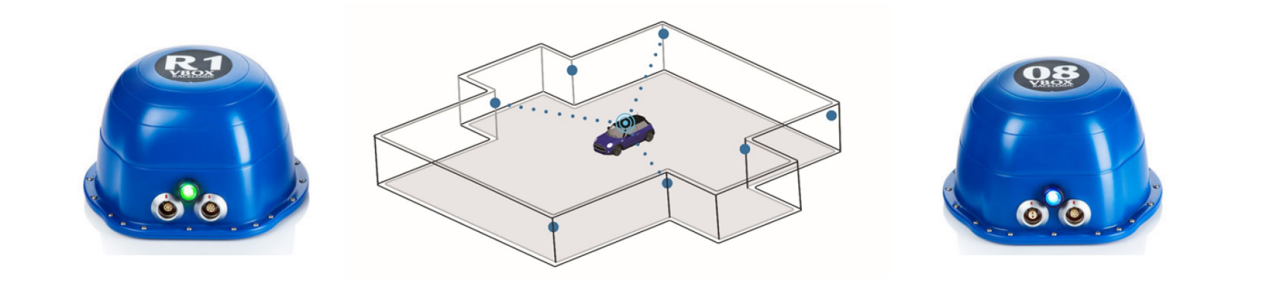
VIPS builds a localized positioning system by deploying high-precision positioning beacons across the indoor test site, allowing test vehicles to receive stable and continuous high-precision positioning data. Its typical performance features include:
Centimeter-level dynamic positioning accuracy
High-frequency data output (up to 100 Hz)
High-precision speed and attitude information output
Seamless transition between indoor and outdoor positioning
Continuous positioning testing from outdoor to indoor when integrated with GNSS systems
Linkage with dynamic testing platforms to build a comprehensive testing system
Accuracy unaffected by rain or fog
Beacons supporting uninterrupted (24/7/365) continuous operation with high reliability
Interlocking with Dynamic Test Platforms
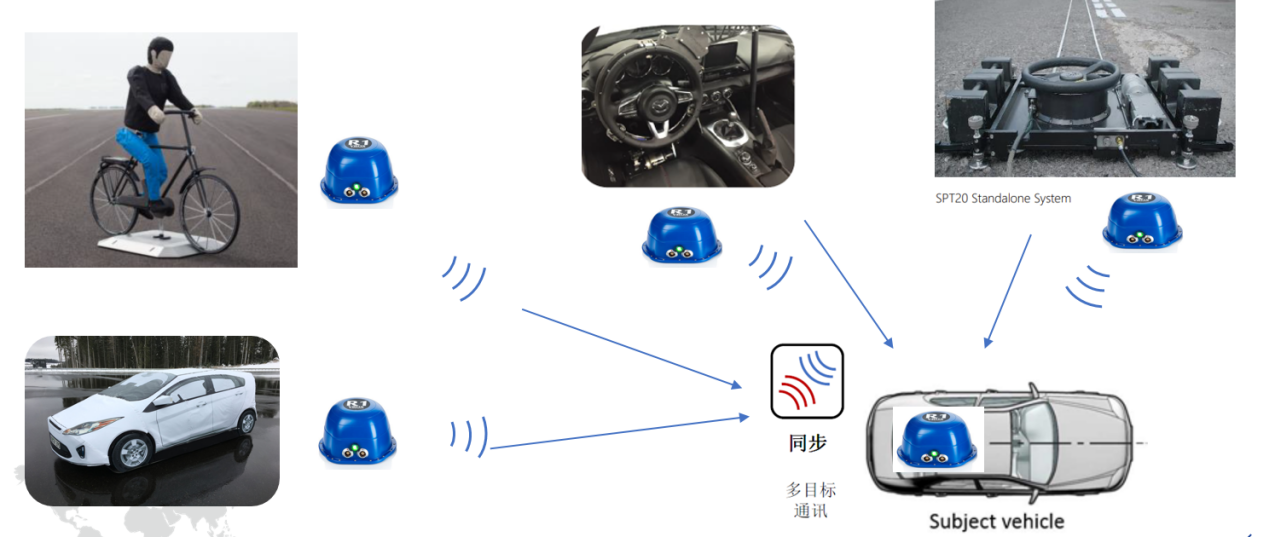
In the verification of complex parking scenarios, high-precision positioning is used for more than just data recording. The VIPS system can interact and share data with AB Dynamics' mobile test platforms. By providing real-time, precise position and speed information of vehicles and target objects, the system achieves the following:
Supports the trajectory control of mobile target platforms
Enables precise coordination between the vehicle and dynamic targets
Enhances the stability and repeatability of testing in complex scenarios
This capability allows test engineers to construct more complex and reproducible scenarios—such as pedestrians crossing a parking path, interference from a preceding vehicle pulling out, and multi-target dynamic interactions—thereby achieving comprehensive verification of automated parking systems under real-world conditions.
Automated Parking Testing is Entering a Systematic Era
As automated parking functions continue to grow more complex, the testing systems must continuously upgrade alongside them. High-precision positioning systems are becoming the essential infrastructure supporting this evolution. With the ongoing integration of indoor positioning technologies and dynamic testing equipment, automated parking testing will be conducted in increasingly realistic and repeatable environments, providing highly reliable testing support for the safe commercialization of intelligent driving technologies.
About the Distributor: As the exclusive representative of Racelogic in China, Guangzhou Zeer Testing Technology Co., Ltd. has long been dedicated to the field of automotive testing and measurement technology. The company provides domestic automakers, testing institutions, and scientific research units with high-precision testing solutions and technical services—including VIPS—to drive the practical application of indoor high-precision positioning technology in autonomous driving test scenarios.